
Product Photos Cooperative Morocco: A Simple Guide
Are your products as beautiful in photos as they are in real life?

In This Article
- Why do photos matter for a Moroccan cooperative?
- Choosing the right spot and the right light
- Preparing the product before taking the photo
- Choosing a simple, well-suited background
- Mastering framing and different types of photos
- Using your smartphone to get better photos
- Editing photos without distorting the product
- Adapting your photos to different digital channels
- A good photo can give your products new value
- Let's talk about it
A cooperative can spend months perfecting a product — a well-pressed argan oil, a quality honey, a hand-woven rug — and still see its online sales stagnate. The problem is often that the photo doesn’t properly show what’s good about the product: its texture, its colors, its packaging, its craftsmanship.
On a website, on Instagram, on Facebook, on WhatsApp Business or in an online catalog, the photo is almost always the first thing a potential customer looks at. Even before reading the description, they’re already judging the product with their eyes.
The good news is that good product photos cooperative morocco shops can use don’t require a professional camera or a studio to change this perception. With a few simple good practices around light, framing, backdrop and preparation, it’s already possible to better showcase a product and give a more professional image of the work behind it.
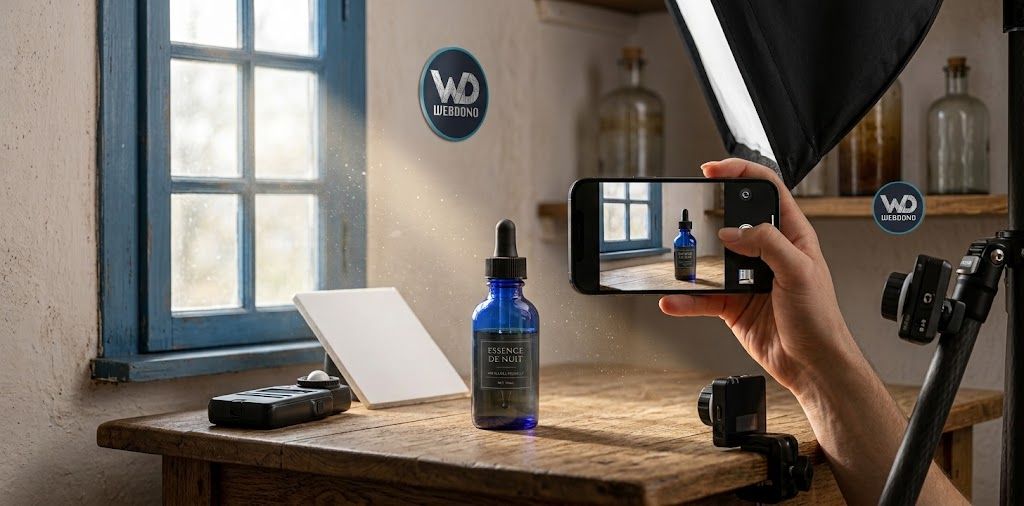
In the Moroccan context, where many cooperatives work with limited resources, this article starts from a simple principle: everyone can do better with what they already have in hand, starting with a smartphone.
Why do photos matter for a Moroccan cooperative?
A product photo doesn’t just “show” an item. It catches attention in an Instagram feed or a WhatsApp gallery, helps the customer understand what they’re buying, and builds trust in the cooperative that makes it.
For an argan oil, a clear photo lets you see the product’s color and texture. For a rug or a woven piece, it reveals the handmade patterns and finishes. For honey, spices or artisanal jams, it gives an immediate sense of quality and freshness.
So the real question isn’t whether photos matter — they always do — but how to get the most out of them without a photographer’s budget. A good photo never guarantees a sale on its own, but it removes an obstacle: doubt about the product’s real quality.
What makes the difference isn’t the phone brand or the price of the camera. It’s how the light, the frame and the product’s preparation are thought through before you even press the shutter.
Choosing the right spot and the right light
Natural light remains, by far, the most accessible and effective tool for a cooperative. In practice, it’s enough to photograph near a window, at a time of day when the light is soft — early morning or late afternoon rather than midday.

A few simple habits already change a lot:
-
- placing the product facing the window, never with its back to the light;
- avoiding direct, harsh light, which creates reflections and strong shadows;
- using a simple white cloth or sheet of paper as a reflector, to soften shadows;
- avoiding the phone’s flash, which often gives a flat, yellowish result;
- testing several positions around the light source before picking the best one.
Illustration (fictional example): imagine a women’s cooperative in the Souss region producing argan oil. By simply placing the bottle near a north-facing window, where the light stays stable all day with no direct sun, it would get a true-to-life oil color, with no reflection hiding the label.
The goal is to get an image where the colors, textures and packaging details stay perfectly readable, with no area too dark or too blown out by the light.
Preparing the product before taking the photo
A good photo is prepared before you even take out the phone. For a food, cosmetic or craft product, every detail visible on screen counts double, because the customer can’t touch the product before buying.

Before shooting, a few simple checks avoid most bad surprises:
-
- clean the product and remove dust or handling marks;
- check that the packaging isn’t damaged or poorly closed;
- make sure the label is properly stuck on and legible;
- check the cap or the container’s closure;
- remove unnecessary objects around the product;
- check that the product is intact, with no visible flaw.
Illustration (fictional example): a weaving cooperative in the Middle Atlas could, before each photo, dust off its rugs and smooth the fringes by hand. This simple gesture, repeated systematically, avoids having to reshoot photos later.
This step takes a few minutes, but it avoids publishing an image that gives a careless impression of the cooperative’s work.
Choosing a simple, well-suited background
A cluttered background always draws attention away from the product itself. In practice, a simple background — white, beige, light wood or a neutral cloth — naturally shows off the colors and textures of a craft or food product.
A light wood board works very well for spices or local products. A neutral cloth or a plain tablecloth suits most natural cosmetics. For pottery or textiles, a natural surface can reinforce the product’s authentic feel.
|
A more elaborate setting — a workshop, a loom, a harvest basket — can also be relevant to show the product’s origin and craftsmanship, as opposed to a product photo meant to clearly present the item.
In both cases: don’t overcrowd the composition.
Mastering framing and different types of photos
A cooperative benefits from varying its types of photos rather than always repeating the same angle. Each type of shot answers a specific customer need.
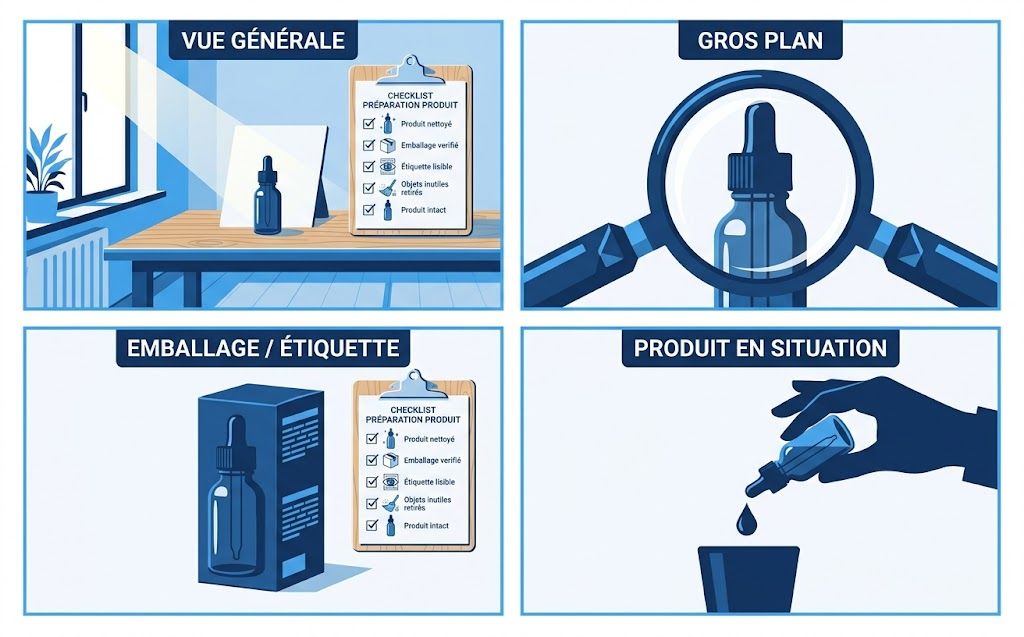
The general product photo
The whole product, well centered, with enough space around it.
The close-up
Details, textures or finishes — the grain of a piece of pottery, the texture of a soap, the tight weave of a rug.
The different sides of the packaging
The label, the information on the back, or the different sides of the packaging.
The product in use
The product used or placed in its natural setting.
|
It’s better to leave space around the product rather than crop it tight, and to adapt the framing to its destination: square photo for Instagram, wider photo for a website, vertical format for WhatsApp Business.
Using your smartphone to get better photos
A recent smartphone is largely enough to get started. What makes the difference isn’t the device model, but how it’s used.
-
- clean the lens with a soft cloth before each session;
- always favor natural light over flash;
- avoid digital zoom — it’s better to physically get closer to the product;
- stabilize the phone to avoid blur;
- turn on the camera’s framing grid in the settings;
- take several photos from slightly different angles;
- check sharpness directly on the screen.
It’s better to fully master the tool you already have than to wait for ideal equipment before starting to publish.
Editing photos without distorting the product
A light edit can improve a photo without transforming it: brightness, contrast, exposure and, if needed, a slight crop.
The rule to never forget: the photo must stay true to the real product.
Avoid:
-
- colors that are excessively saturated and no longer match reality;
- overdone edits that give an artificial look;
- removing important details;
- any change that could mislead the customer about the product’s real appearance.
Adapting your photos to different digital channels
The same photo can often be reused, but it sometimes needs a few adjustments. A website, an Instagram page, an online store or a WhatsApp Business catalog don’t all have exactly the same format constraints.

A showcase site or an e-commerce store generally accepts wider photos. Instagram favors square or vertical formats. WhatsApp Business favors simple, direct photos.
This is also where digital support can make a difference: beyond the photos themselves, social media management and the presentation of an online catalog rely directly on the quality of the product visuals. An agency specialized in the digital support of Moroccan cooperatives and small businesses can help structure this presence.
A good photo can give your products new value
Taking beautiful product photos doesn’t only depend on the equipment available. Well-used natural light, a properly prepared product, a simple background, careful framing, a well-mastered smartphone and light editing are already enough to transform how a product is presented, with no heavy investment.
For a cooperative morocco shops rely on, these photos don’t just serve to sell: they also tell a story of craftsmanship, identity and professionalism that deserve to be shown as they really are, with no artifice.
Need help going further with your digital presence?
Let’s talk about it:
- How does your cooperative currently take its product photos?
- Do you use a smartphone or a camera?
- What’s the biggest difficulty you run into when photographing your products?