
7 Digital Marketing Myths Moroccan Cooperatives Still Believe
The complete guide to selling more, modernizing your image and winning new markets

In This Article
- Myth 1: “We must be present on every social network”
- Myth 2: “More followers = more customers”
- Myth 3: “Digital marketing delivers results immediately”
- Myth 4: “Posting a lot is enough to succeed”
- Myth 5: “Facebook/Instagram ads are enough on their own”
- Myth 6: “SEO is reserved for big companies”
- Myth 7: “AI can completely replace a digital marketing strategy”
- FAQ
Today, digital marketing is no longer optional for Moroccan cooperatives that want to sell beyond their region, showcase their know-how and reach new customers, including for export.
Yet investing in digital does not automatically mean getting good results. Many cooperatives still start out with preconceived ideas: be present everywhere, collect followers, post every day, or expect immediate results.
The problem is not always the budget, which is often limited for a cooperative. It often lies in how that budget — and the members’ time — is used.
Between social media, SEO, online advertising, content, email marketing and now artificial intelligence, cooperative managers can easily find themselves facing a multitude of choices.
In this article, we will debunk 7 digital marketing myths that are still very common among Moroccan cooperatives today, and understand how to build a more coherent approach to digital marketing for cooperatives.
Myth 1: “We must be present on every social network”
This is probably one of the first preconceived ideas when a cooperative starts its digital transformation.
Facebook, Instagram, TikTok, LinkedIn, YouTube, Pinterest… Faced with the popularity of these platforms, some cooperatives think they should create an account everywhere to maximize their visibility.
In reality, being on five platforms without the necessary resources can be far less effective than seriously mastering one or two channels. A digital presence takes time: content creation, replying to comments, following up on messages, analyzing results, adapting formats and managing the community — time that cooperative members also need to devote to production.
A Moroccan cooperative that posts three times a month on five different networks therefore risks producing irregular and inconsistent content. Conversely, a cooperative that identifies its audience and chooses two relevant channels can gradually build a real community around its know-how.
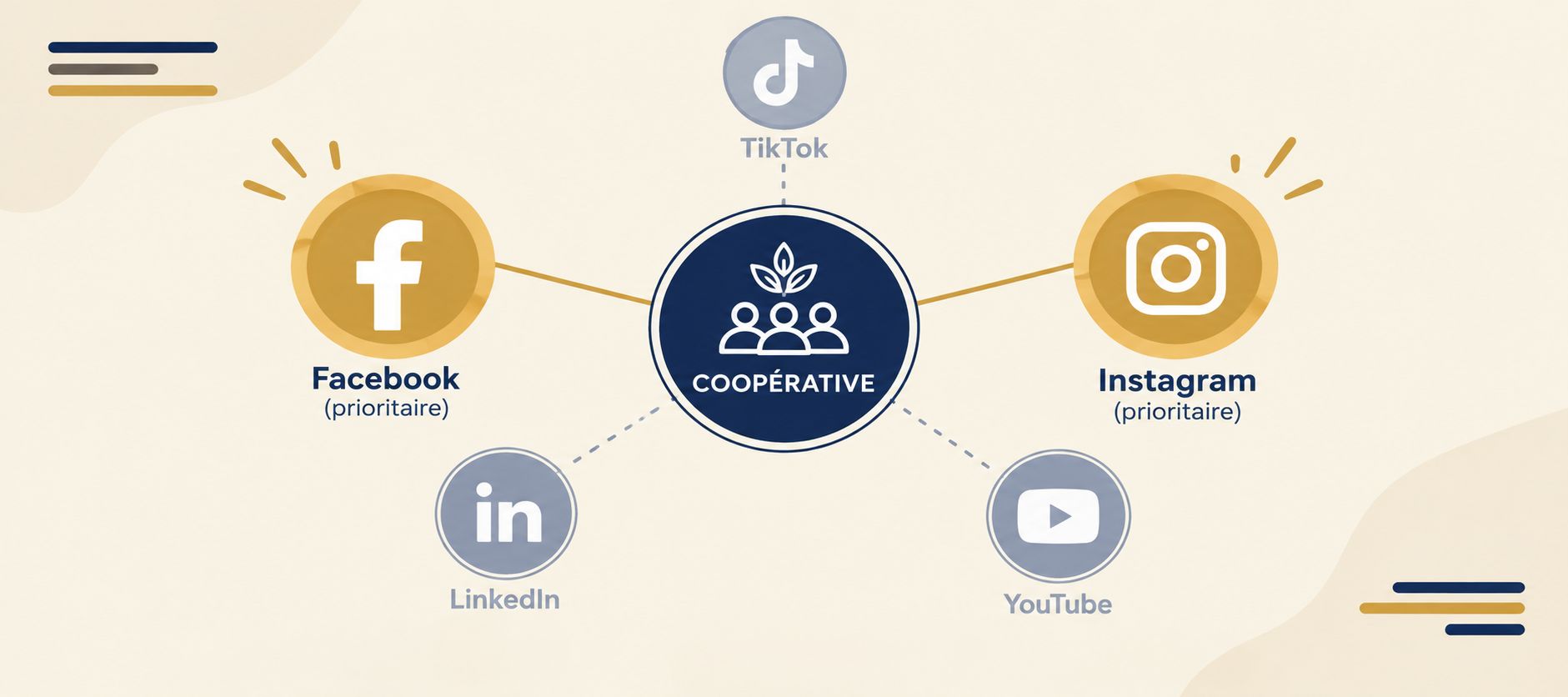
How to choose the right network for your target?
The choice of network must start with the customer, not with the popularity of the platform.
A highly visual cooperative (weaving, pottery, basketry) will often find more opportunities on Instagram and Pinterest, where the finished product and the artisan’s gesture show well.
A cooperative that sells B2B — hotels, organic shops, export distributors — can favor LinkedIn and its website to reassure professional buyers. A local food cooperative can combine Facebook, Instagram and local SEO to reach people in its region.
|
The channel must then be adapted to the resources available within the cooperative. It is better to regularly produce useful content on two platforms than to post automatically everywhere without a real strategy.
Myth 2: “More followers = more customers”
An account with 50,000 followers may seem more successful than one with 5,000. But followers don’t pay the cooperative’s bills.
The number of followers is a visibility metric, but on its own it cannot measure the profitability of a marketing strategy. A cooperative can have a large audience and generate very few orders. Conversely, a small, highly targeted audience — for example organic professionals or export buyers — can produce truly interested prospects.
This is the difference between audience and conversion. “Vanity metrics” include the number of followers, likes or certain impressions. They can be useful for analyzing visibility, but they should not become a cooperative’s main performance indicators.
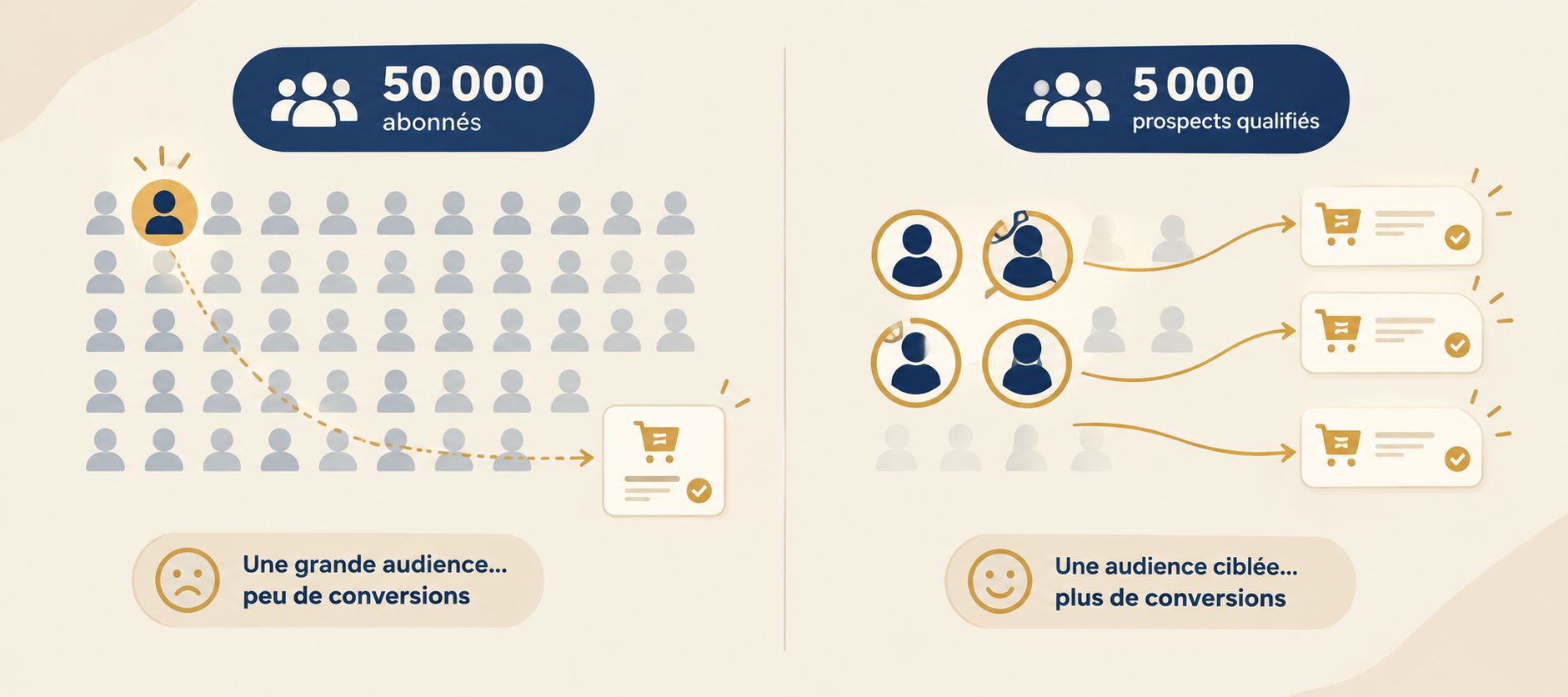
Fictional example — flag before publishing: Imagine a women’s argan oil cooperative with 40,000 Instagram followers but very few export quote requests. A second cooperative, with only 3,000 followers but well targeted (organic buyers, specialty shops, importers), receives several concrete requests every month. This example is purely illustrative; it reflects a common situation but is not based on any real data.
The indicators to track instead
The conversion rate measures the proportion of visitors or prospects who take the desired action: filling in a form, requesting a quote, ordering a product or visiting the cooperative.
- The CAC (Customer Acquisition Cost) is the average cost needed to acquire a new customer or buyer.
- The LTV (Customer Lifetime Value) represents the value generated by a customer over the whole length of their relationship with the cooperative — for example, a loyal buyer who regularly reorders argan oil or honey.
Other indicators can also be tracked: number of qualified leads, cost per lead, revenue generated, average basket or return on ad spend. The goal is therefore not to get “more likes”, but to understand how marketing efforts really contribute to the cooperative’s development.
Myth 3: “Digital marketing delivers results immediately”
One of the most frequent misunderstandings concerns the speed of results. A cooperative invests in a website or in content for a few weeks, sees little change and quickly concludes that “digital doesn’t work”. The problem is often about expectations: not all digital levers take the same time to mature.
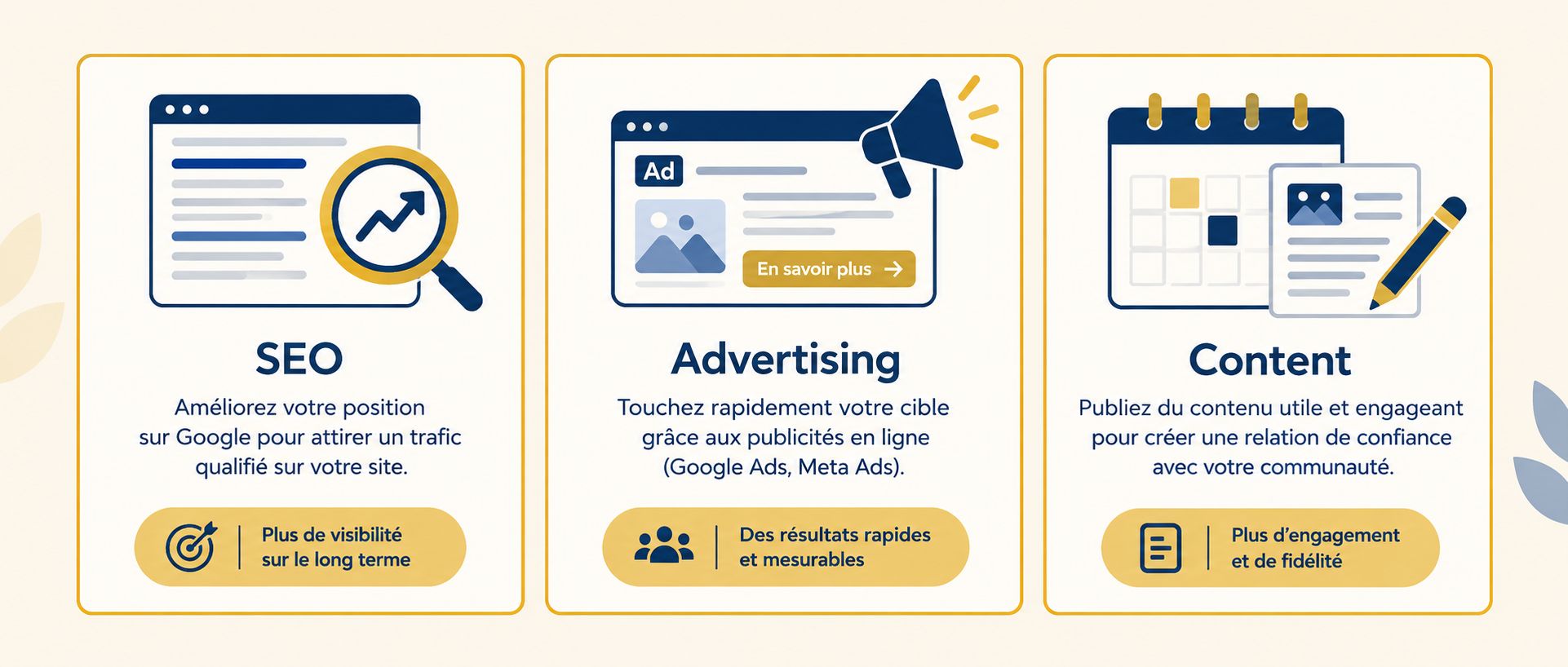
SEO, for example, relies on the gradual optimization of a site, its content, its authority and its visibility in search engines. For a cooperative targeting searches like “organic argan oil Morocco” or “handmade weaving cooperative”, results may take several months depending on competition and the initial state of the site.
Paid advertising, for its part, can generate traffic or requests much faster, but it requires a continuous budget and regular optimization — a budget that a cooperative must plan carefully. Organic content often sits somewhere in between.
SEO vs Ads vs organic social
| Lever | Usual timeframe | Cost | Durability |
| SEO | Several months | Gradual investment | High if the work is maintained |
| Paid Ads | Fast, sometimes within days | Continuous ad budget | Low once campaigns stop |
| Organic social | Variable | Time + content production | Medium to high depending on audience |
These timeframes are general guidelines, not guarantees. The right strategy often consists of combining several horizons: use Ads to quickly generate visibility or orders during a season (harvest, holiday, trade show), while building a more lasting asset through SEO and content.
Myth 4: “Posting a lot is enough to succeed”
Posting every day is not a strategy in itself. A cooperative can produce thirty posts a month without managing to clearly explain what it offers, what makes its know-how different or how it can meet its customers’ expectations.
Content must respond to an intention. Before publishing, ask yourself:
- Who is this content for?
- What problem does it solve?
- What information does it bring?
- What action do we want to trigger?
- Is it consistent with the cooperative’s image and values?
An editorial line answers these questions. It defines the themes, the tone, the formats, the priority topics and the way the cooperative communicates.
|
Quality does not necessarily mean producing long or complex content. A short video showing how a product is made, a case study or a post that answers a customer question precisely can be worth more than several generic pieces. Today, the challenge is no longer simply to “post”. It is to become useful and to tell an authentic story.
Myth 5: “Facebook/Instagram ads are enough on their own”
Facebook and Instagram can be excellent acquisition levers for a cooperative. But no single platform should represent its entire digital strategy.
A cooperative that depends entirely on one channel also depends on its rules, its advertising costs, its algorithms and changes in user behavior. A campaign can work for several months and then become less profitable. The acquisition cost can rise. An audience can become less receptive.
That is why it is better to build several acquisition sources. A cooperative can, for example, combine:
- SEO to capture people who are actively searching for a local product or craft;
- Facebook and Instagram advertising to reach targeted audiences, possibly complemented by video advertising to show the know-how in motion;
- Content to build trust and share the cooperative’s story;
- Email marketing to maintain a relationship with professional buyers and loyal customers;
- Website / online store to centralize information, requests and orders, including for export.
The website plays a particularly important role here: unlike a social page, it is a space that belongs directly to the cooperative. WebDono presents the e-commerce website as a digital showcase that lets you sell directly, present the cooperative and reassure buyers, including internationally.
Diversification does not mean doing everything at once. It means avoiding building a cooperative’s whole marketing activity around a single point of dependence.
Myth 6: “SEO is reserved for big companies”
SEO can seem out of reach for small cooperatives when they see big brands in the top Google results. Yet cooperatives have an advantage: they can focus on much more precise searches, tied to a specific product and a specific region.
Instead of aiming for an extremely competitive query like “argan oil”, a cooperative can work on more specific searches such as “organic argan oil women’s cooperative”, “handmade Berber rug [region]” or “thyme honey cooperative [city]”.
These niche queries may attract fewer visitors, but visitors who are potentially much closer to buying.
SEO can also support the local visibility of a cooperative that wants to attract customers in a specific region, or professional buyers looking for a reliable supplier.
A cooperative therefore doesn’t necessarily need to compete directly with the biggest brands. It must first identify the searches where its product and its region can become a reference.
Myth 7: “AI can completely replace a digital marketing strategy”
This is probably the most modern myth on this list. Today, artificial intelligence tools can generate texts, analyze data, create ideas, produce visuals, automate certain tasks and speed up production, including for a small cooperative with few marketing resources.
But AI is not a strategy. It can produce ten post ideas in a few seconds. It doesn’t necessarily know which one truly matches the cooperative’s identity, story and values.

That is why AI should be seen as a tool for execution and augmentation, not as the complete brain of marketing. A real digital marketing strategy starts with human and business questions: who are our customers, what problem do they face, why would they choose our cooperative’s products, what goal do we want to reach, which channels are the most relevant, how will we measure the result.
|
For Moroccan cooperatives, this distinction is particularly important. Automatically generated content can be technically correct while being too generic. Yet a cooperative must keep its personality, its cultural context, its vocabulary and the real knowledge of its artisans and customers.
How to build a real digital marketing strategy for a cooperative
After debunking these seven myths, one question remains: how do you concretely take action? An effective strategy can be built around four simple steps.
- Start with an audit — analyze your website, your SEO, your social media, your ad campaigns, your content and your customers’ journey. Identify what already works and what blocks orders.
- Define business goals — a goal must be tied to a concrete action: getting more export quote requests, increasing online sales, generating qualified professional buyers, growing a local customer base or retaining existing buyers.
- Choose a few priority channels — channels must follow the goals, not the other way around.
- Measure, learn and improve — campaigns must be analyzed, content compared, converting pages identified, and low-profit campaigns adjusted or stopped.
|
It is this improvement loop that turns a simple digital presence into a real digital marketing strategy. The ultimate goal is not to be everywhere. It is to be in the right place, with the right message, in front of the right buyers, at the right time.
Effective digital marketing does not rest on the number of posts, followers or platforms used. It rests above all on a coherent strategy, measurable goals and a good understanding of buyers, whether local, national or for export.
Today, Moroccan cooperatives have more tools than ever: social media, SEO, digital advertising, content, automation and artificial intelligence. But more tools do not necessarily mean better results. The priority must be to choose the right levers, adapted to the cooperative’s resources, and to use them with method.
This is exactly the kind of support Webdono offers to Moroccan cooperatives that want to structure their digital strategy, whether through a website, an SEO strategy, a social media presence or digital advertising.
And you, where does your cooperative stand today? Is your digital marketing strategy based on data or on habits? Which myth on this list surprised you the most? Feel free to share your experience in the comments.
CONTACT
Is your cooperative investing in digital without knowing exactly what works? WebDono can analyze your online presence, identify your main opportunities and help you build a digital strategy adapted to your cooperative
FAQ
Why Your Blog Posts Are Not Getting Traffic
1. What are the main digital marketing myths for a cooperative?
The main myths are: having to be on every social network, believing that followers guarantee sales, expecting immediate results, thinking that posting a lot is enough, depending only on Facebook or Instagram, considering SEO reserved for big companies, and believing that AI can replace a marketing strategy.
2. How long does it take to get results with SEO?
SEO generally takes several months before delivering significant results. The timeframe depends on competition, the state of the site, the content, the targeted keywords (for example those tied to a specific product or region) and the domain’s authority.
3. Does a Moroccan cooperative need to be on every social network?
No. A cooperative benefits from selecting the networks where its target audience really is and where it can regularly publish relevant content. Two well-managed channels can be more effective than five neglected accounts.
4. Do many followers mean more sales for a cooperative?
No. The number of followers mainly measures the size of an audience. To assess commercial effectiveness, it is better to track conversions, customer acquisition cost, qualified leads, revenue generated and customer value.
5. Can artificial intelligence replace a digital marketing strategy for a cooperative?
No. AI can speed up content creation, analysis and some repetitive tasks, but it does not replace an understanding of the market, the customers, the cooperative’s identity and its business goals. It must be used as a tool serving the strategy.


