
Community Manager or Agency for Your Cooperative Morocco

In This Article
- Why this question comes up earlier than you'd think
- What a community manager actually does
- Option 1: Hiring an in-house community manager
- Option 2: Outsourcing to a specialized agency
- The real calculation: When each option makes sense
- A third, often forgotten option: The hybrid model
- Concrete example: A cooperative's choice in Tangier
- What to look for before signing with an agency
- What to look for before hiring in-house
- Red flags to watch for, on either side
- A rough budget comparison
- Revisiting the decision over time
- A short checklist before deciding
- A decision about volume, not principle
- FAQ
As soon as a Moroccan cooperative decides to take its social media seriously, the same question keeps coming up: should it hire a full-time community manager, or hand this job over to an external agency? Both options exist, cost differently, and suit very different situations.
This article offers an honest calculation — with no bias toward either option — to help a Moroccan cooperative morocco decide based on its size, its budget and its real goals.
Why this question comes up earlier than you’d think
Many cooperatives manage their social media “in-house, a bit by everyone” during the first months — the president posts a photo, a motivated member handles it between other tasks. This approach works for a while, until the cooperative grows and the lack of dedicated skill starts to show: irregular content, no strategy, no measurable results.
This is exactly the moment when the question becomes real: structure this activity with a dedicated role, or outsource it to specialists who already manage several accounts.
Postponing this decision has a real cost, even if it stays invisible at first glance: every month without a clear strategy is a month of visibility lost to better-organized competitors, and an opportunity to build trust with the audience that isn’t easily recovered once it has passed.
What a community manager actually does
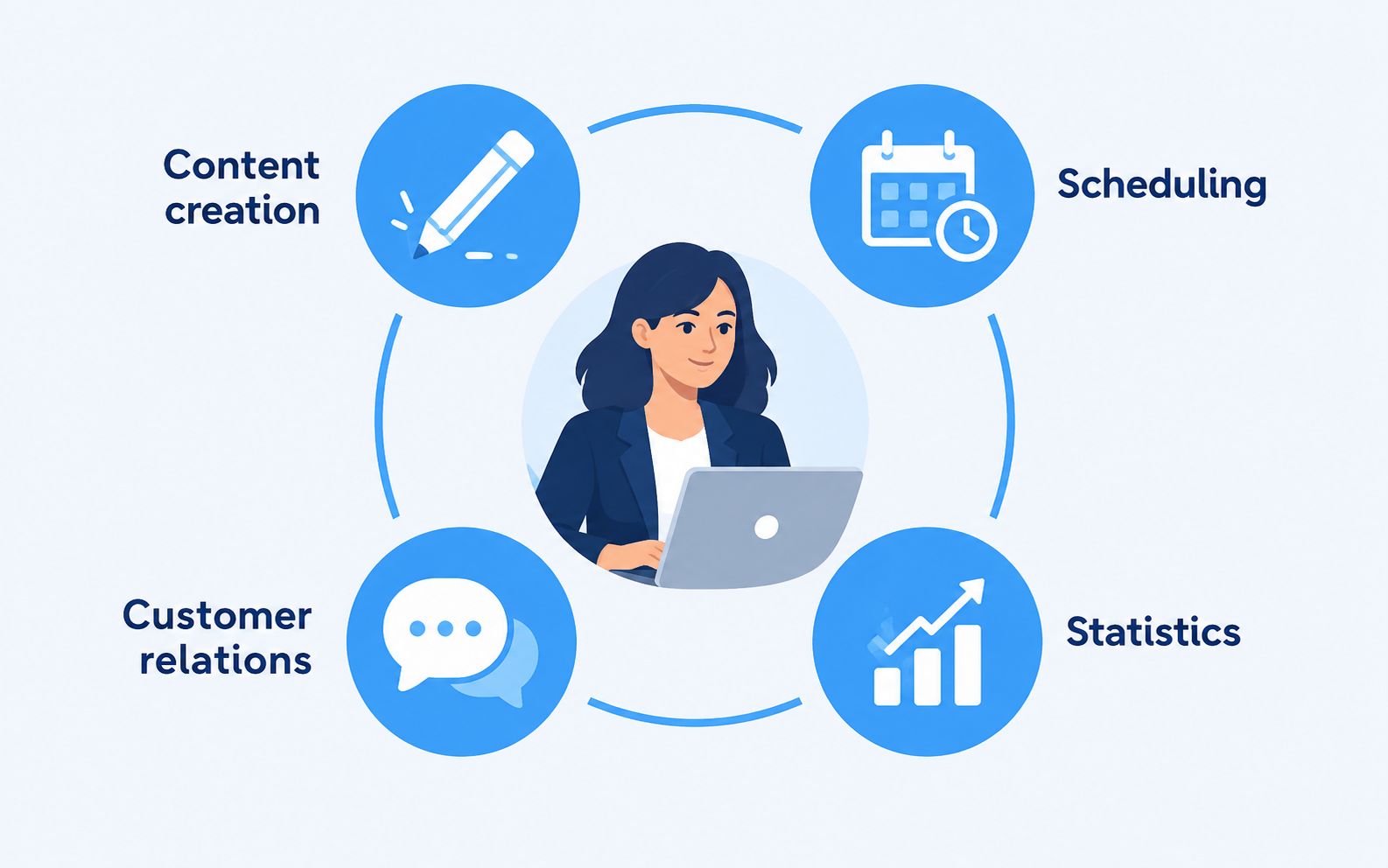
A community manager is the person responsible for creating content, scheduling posts, replying to messages and comments, and tracking engagement statistics on a cooperative’s social media. Depending on the structure, this role can expand to managing advertising campaigns, or stay purely organic.
|
Option 1: hiring an in-house community manager
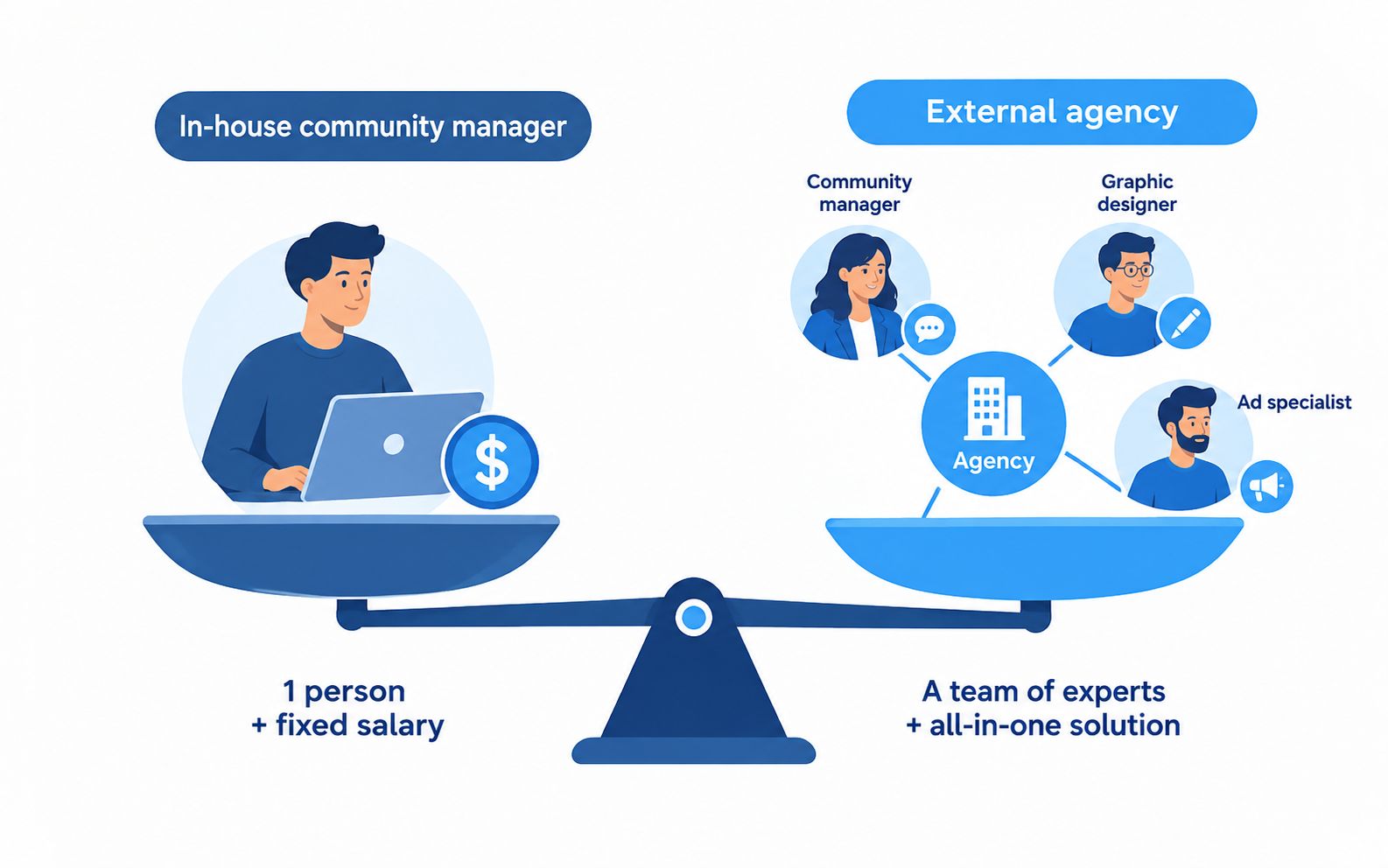
Having a salaried community manager offers a real advantage: deep, immediate knowledge of the cooperative, its products and its story, with no need to explain context before every new post. The person is continuously available and can react quickly to something happening in the cooperative’s daily life.
This option, however, involves a fixed financial commitment — a monthly salary, regardless of the actual workload in any given week — as well as a dependence on a single person: if that person is absent or leaves, the cooperative’s social presence can be interrupted overnight.
You also need to factor in recruitment and training time: finding the right person, checking their real skills in content creation and advertising management, then supporting them through their first months represents a time investment that many cooperative managers underestimate at the decision stage.
Option 2: outsourcing to a specialized agency
An agency brings a team rather than a single person: a community manager, but also a graphic designer, a paid-advertising specialist and a strategic vision built on experience with many other clients. This range of skills generally goes beyond what a single in-house position can cover.
The cost, often structured as a monthly subscription, is generally more predictable and flexible than a full-time salary, with the possibility of adjusting support to actual needs at any given moment — a spike in activity before a holiday or a craft fair, for example, or a quieter period.
Comparison table included in the article Content Strategy: Cost, Skills, Continuity, Knowledge of the cooperative, Day-to-day responsiveness.
The real calculation: when each option makes sense
The decision threshold rarely depends on the cooperative’s size alone, but on the actual workload that social media represents. A cooperative posting twice a week with a limited volume of customer messages generally doesn’t need a full-time position — an agency or a shared-time community manager is largely enough.
Another factor worth considering: the maturity of the strategy itself. A cooperative that’s just starting out and still trying to define its social media positioning often benefits more from the collective experience of an agency, which has already guided other cooperatives or small businesses through similar choices, than from the isolated learning curve of a single person hired with no track record in this field.
Conversely, a cooperative whose business activity depends heavily on social media — active online sales, strong customer relations through messaging, daily content needed — reaches, more quickly, a volume that justifies a full-time in-house position, possibly complemented by an agency for advertising strategy and graphic design.
A simple indicator helps make this decision more objective: counting the number of hours actually needed each week to create content, reply to messages and analyze results. Below 15-20 hours a week, an agency or shared time generally remains more cost-effective than a full-time salary.
A third, often forgotten option: the hybrid model
Many Moroccan cooperatives actually opt for a middle-ground solution: an agency for content strategy, content creation and advertising campaigns on Facebook and Instagram, combined with an in-house person for daily customer relations and on-the-ground responsiveness. This model combines the professional strategy of a specialized team with the responsiveness of an in-house presence.
Concrete example: a cooperative’s choice in Tangier
Let’s take the fictional case of a processed seafood products cooperative in Tangier, which had been posting irregularly for two years, managed in turn by different members with no real continuity. Facing growing competition on Instagram, the cooperative’s board had to choose between hiring a full-time community manager or outsourcing to an agency.
The actual workload — two to three posts a week, managing customer reviews, and occasionally targeted ad campaigns — didn’t justify a full-time salary. The choice fell on an agency, with a monthly subscription covering strategy, content creation and ad management. Six months later, the renewed consistency of posting and the targeting of campaigns had noticeably increased orders generated through Instagram, for a cost lower than that of a full-time salary.
What to look for before signing with an agency
Not every agency offers the same level of support, and a cooperative evaluating this option should ask a few direct questions before committing to a monthly subscription. Does the agency have experience working with cooperatives or small producers specifically, or mainly with larger businesses that have very different needs and budgets? Who exactly will be working on the account day to day, and will that be a dedicated contact or a rotating team with little continuity?
It’s also worth asking how results are reported, and how often. A serious agency should be able to show, in plain terms, what changed from one month to the next — more engagement, more messages, more orders — rather than only presenting vanity numbers like follower count. Finally, it helps to clarify upfront what happens if the cooperative wants to pause or end the contract: a flexible, short-notice arrangement is generally a better fit for a cooperative still testing what works than a long, rigid commitment.
What to look for before hiring in-house
On the other side, a cooperative considering a direct hire should think beyond the interview itself. A candidate’s portfolio matters, but so does their ability to work with limited resources — not every community manager has experience producing good content with just a smartphone and no advertising budget, which is often the reality for a Moroccan cooperative in its first year of digital activity.
Illustrative example: a food cooperative in the Rif region interviewing candidates for an in-house role could ask each one to propose, on the spot, three post ideas using only what the cooperative already has on hand — no studio, no paid tools. The answers alone often reveal more about real-world fit than years of listed experience on a resume.
It also helps to plan for the first three months as a trial period with clear, modest expectations, rather than assuming results will appear immediately. A new hire, however skilled, still needs time to understand the cooperative’s products, its members and its customers before their content truly reflects that knowledge.
Red flags to watch for, on either side
Whichever option a cooperative leans toward, a few warning signs are worth taking seriously. On the agency side: vague promises of guaranteed follower growth with no mention of actual sales or engagement, reluctance to share past client examples, or a contract that locks the cooperative in for a long period with no easy exit. On the in-house side: a candidate who can’t clearly explain how they would measure success, or who proposes a content plan built entirely around generic trends with nothing specific to the cooperative’s own products and story.
In both cases, the underlying question stays the same: does this option genuinely understand the cooperative’s reality, or is it offering a one-size-fits-all approach borrowed from a completely different kind of business?
A rough budget comparison
It helps to put real numbers next to these two options, even approximate ones, rather than comparing them only in the abstract. A full-time in-house community manager typically represents a fixed monthly salary, plus the usual employer costs that come with any formal hire in Morocco, regardless of how busy or quiet a given month turns out to be.
An agency subscription, by contrast, is usually tiered: a smaller package for a cooperative posting a few times a week with light customer interaction, and a larger one once advertising management, more frequent content and faster response times are added. For many small and mid-sized Moroccan cooperatives, a mid-tier agency package ends up costing noticeably less per month than a full-time salary, while still covering strategy, content creation and basic ad management — three things a single in-house hire would otherwise need to handle alone.
This doesn’t mean an agency is always cheaper in every case. A cooperative with very high daily messaging volume, for instance, may find that an agency’s response-time guarantees cost extra, to the point where an in-house hire focused specifically on customer relations becomes the more economical choice. This is exactly why the earlier hours-per-week calculation matters more than any general rule of thumb.
Revisiting the decision over time
Whichever option a cooperative chooses first doesn’t have to be permanent. A cooperative’s social media workload tends to grow as its online sales grow, and a solution that made sense in year one can become insufficient, or unnecessarily expensive, by year three.
A simple habit solves most of this: revisiting the hours-needed-per-week calculation roughly once a year, or whenever something changes significantly — a new product line, a move into online sales, a noticeable jump in customer messages. A cooperative that started with an agency because its workload was light may well outgrow that arrangement and move toward a hybrid model, or eventually a full in-house position, once social media becomes a core part of how it sells rather than a side activity.
A short checklist before deciding
Before making a final call, a cooperative’s board can walk through a short list of practical questions together: how many hours per week does social media realistically take up today, counting content creation, replies and basic tracking? Is that workload likely to grow significantly over the next year? Does the cooperative already have someone with the right skills and enough available time, or would a new hire be starting from scratch? And finally, is the main goal right now building a long-term strategy from the ground up, or simply keeping a basic, steady presence going without much complexity?
Answering these four questions honestly, as a group rather than relying on a single person’s impression, usually makes the decision far clearer than comparing the two options in the abstract. For many Moroccan cooperatives starting out, the honest answer points toward an agency or a hybrid model first, with the option to revisit an in-house hire once the workload and the budget genuinely justify it.
Whatever the choice, the goal stays the same: a social media presence that reflects the cooperative’s real work and story, run consistently enough that customers notice, without over-committing a limited budget to a solution the cooperative isn’t actually ready to use at full capacity.
It’s also worth remembering that this decision doesn’t need to be made in isolation. Talking to other cooperatives in the same region or sector, even informally, often surfaces practical details — real monthly costs, how long a transition took, what went wrong the first time — that no amount of online research can fully replace. A short conversation with a cooperative that already went through this choice can sometimes save months of trial and error.
Finally, it’s worth accepting that the first choice won’t necessarily be the perfect one, and that’s fine. What matters more than getting it exactly right on the first try is building the habit of checking, every few months, whether the current setup still matches the cooperative’s real needs — and being willing to adjust it when it doesn’t, without ever treating a later change of direction as a sign of failure.
Not sure which option to pick?
An audit can evaluate the real workload of your social media and determine the most cost-effective solution for your cooperative.
A decision about volume, not principle
There’s no universally right answer between an in-house community manager and an external agency — only an answer suited to the real workload, the available budget, and the strategic importance of social media in the cooperative’s business model.
The best way to decide remains evaluating this workload objectively before committing, rather than defaulting to whatever neighboring cooperatives happen to be doing. An underused full-time position costs a lot with no real justification; an agency that’s insufficiently involved for too large a workload can, on the other hand, hold back the cooperative’s growth.
FAQ
Community manager and social media management for cooperatives
What does a community manager do, and does a cooperative need one?
It’s the person responsible for creating content, posting regularly and managing customer relations on social media. The need mainly depends on the real workload: a cooperative that posts rarely generally doesn’t need a dedicated full-time position.
How much does a community manager cost in Morocco?
The cost varies widely depending on experience and working time (full-time, part-time, freelance). An agency generally offers a more predictable monthly subscription, covering a full team rather than a single person.
Is an agency more expensive than hiring an employee?
Not necessarily. An agency subscription often includes several skills (strategy, creation, advertising) for a cost that generally stays below an equivalent full-time salary, especially for a moderate workload.
Can you combine an in-house community manager with an agency?
Yes, it’s even a common solution: the agency handles strategy and advertising campaigns, while an in-house person manages daily customer relations and on-the-ground responsiveness.
At what activity level does a full-time position become necessary?
Generally when social media requires daily content, strong customer relations through messaging, or active sales directly through these channels. Below that threshold, an agency or a shared-time community manager is largely enough.