
Content Creation for a Moroccan Cooperative: Why Posting Without a Strategy Gets No Results

In This Article
- Why posting without a strategy leads nowhere
- Step 1: Define a clear goal before creating
- Step 2: Truly know your audience
- The content formats that work best for a Moroccan cooperative
- Step 3: Choose 2 to 3 channels, not ten
- Step 4: Build a realistic editorial calendar
- Concrete example: from a passive presence to content that converts
- Strategic consistency rather than volume
- FAQ
This article explains why “posting more” isn’t enough, and how to build a simple, realistic, genuinely profitable content strategy for a Moroccan cooperative.
Why posting without a strategy leads nowhere
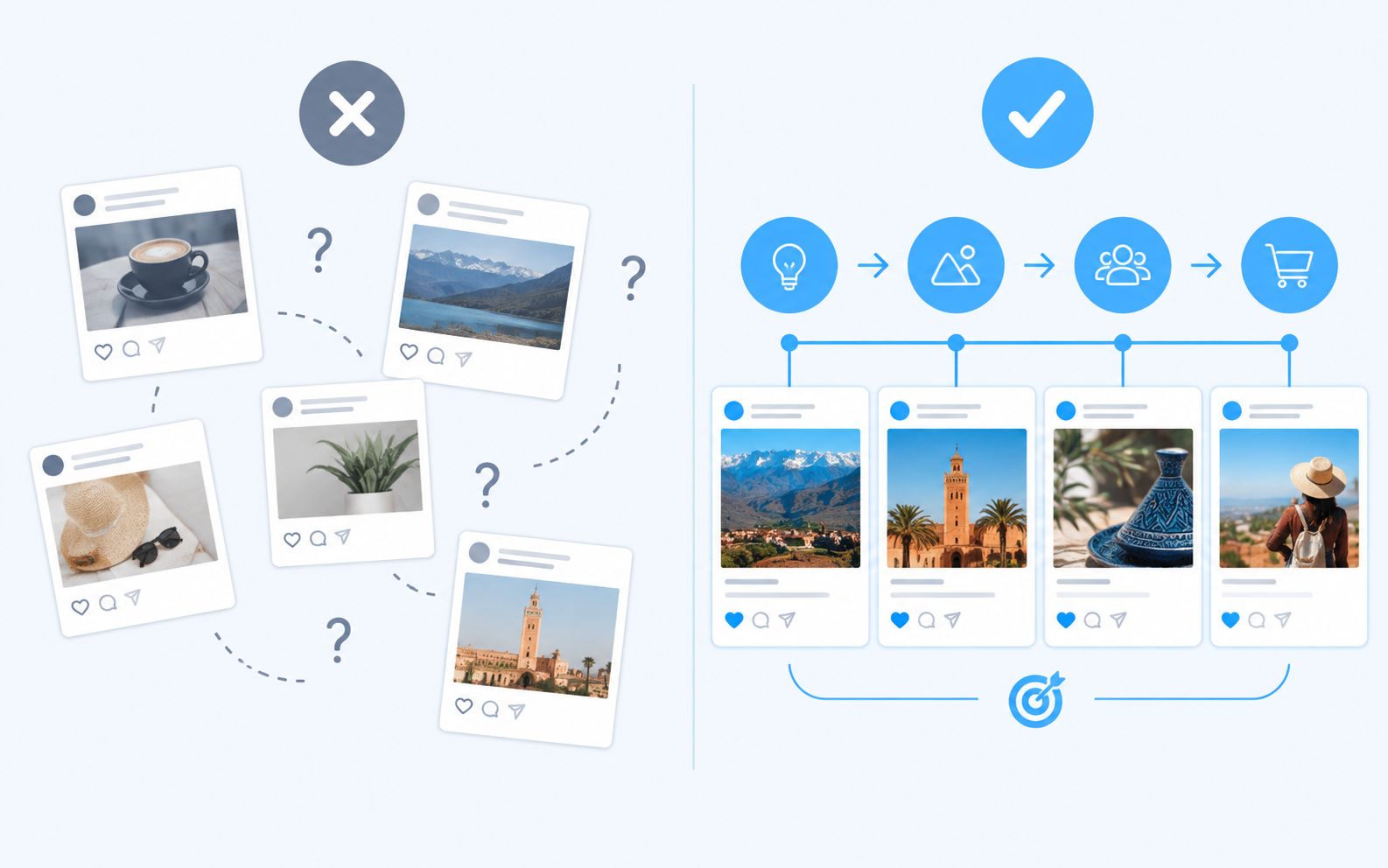
A single post, however beautiful, builds nothing if it isn’t connected to a specific goal. Without a strategy, each piece of content is decided under time pressure, often the day before it’s published, with no link to what was posted before or what will come after.
A content strategy reverses this logic: it defines in advance what to publish, for whom, on which channel, and for what business purpose. Each post then becomes part of a coherent whole, rather than one more isolated post.
This difference shows up very concretely in the results. A page that posts at random accumulates content disconnected from one another, with no thread the audience can recognize. A page that follows a strategy, on the other hand, builds a clear identity over time: visitors know what to expect, recognize the cooperative’s tone, and gradually build trust — an essential ingredient before any purchase decision.
Step 1: Define a clear goal before creating
Even before thinking about the visual or the text of a post, you need to answer a simple question: what is this content for? Making a new product known, answering a frequent customer question, or prompting someone to get in touch are not the same goal — and therefore don’t call for the same content.
|
Content with no goal cannot be measured, and content that cannot be measured cannot be improved. This is the first building block of any content strategy.
Step 2: Truly know your audience
Creating content for “everyone” often ends up speaking to no one in particular. A cooperative needs to know precisely who it is trying to reach: a local customer who already knows the product, a tourist discovering it, or a reseller comparing several suppliers before deciding, for example.
This knowledge of the audience directly shapes the tone, the vocabulary and even the time of posting. Content designed for a specific customer always converts better than generic content designed for no one in particular.
Concretely, this comes down to a few simple questions to ask before each post: who is my typical customer, what problem are they trying to solve, and at what time of day do they usually check their social media. A cooperative that mainly sells to resellers won’t have the same posting schedule or the same tone as a cooperative that speaks directly to individuals or tourists.
The content formats that work best for a Moroccan cooperative
Not all content formats are equal, and there’s no need to master all of them. Three formats come up again and again among Moroccan cooperatives that get good results, without requiring a dedicated creative team.
The customer testimonial remains one of the most convincing formats: a sincere sentence from a satisfied customer, paired with a simple photo, reassures more than a sales description of the product. Content that shows the production steps (harvesting, weaving, cold-pressing) works particularly well for cooperatives, because it makes visible a know-how the customer would never otherwise see. Finally, educational content — a usage tip, a storage trick — positions the cooperative as an expert rather than a simple seller, while bringing real value to the visitor even before they become a customer.
Short-form video deserves particular attention: it captures more attention than a still image and remains, today, the format most favored by social media algorithms. A cooperative doesn’t need a professional studio to produce it — a stable smartphone and natural light are largely enough to show a weaving workshop or a production step.
Step 3: Choose 2 to 3 channels, not ten
A common mistake is wanting to be present everywhere — Instagram, Facebook, TikTok, LinkedIn — with the same limited resources as a single well-managed platform. The result is often a diluted presence across every channel, with excellence on none.
The trap of wanting to be everywhere
It’s better to choose two or three channels genuinely frequented by your target audience, and post there consistently, than to be present everywhere irregularly. A presence on Instagram combined with targeted Facebook campaigns is largely enough for most Moroccan cooperatives in a growth phase.

Step 4: Build a realistic editorial calendar
An editorial calendar doesn’t need to be complex to be effective. What matters is that it’s sustainable over time: two posts a week kept up for six months beats a daily pace abandoned after three weeks.
A simple calendar sets out, for each week, the topic, the format, the channel and the goal of each post. This planning avoids last-minute improvisation, the main cause of inconsistent content.
A simple method is to prepare a week of content in advance, rather than creating each post on the day. This keeps an overall view: checking that posts alternate well between the different goals (inform, reassure, sell), and avoiding publishing two similar pieces of content a few days apart. A simple table with one row per week — date, topic, format, goal — is largely enough for a cooperative that’s just starting out, with no need for a complex tool.
SEO also benefits from this calendar: content posted regularly on the site’s blog, alongside social media, strengthens the cooperative’s SEO visibility over the long run, well beyond the limited reach of a single social post.
Concrete example: from a passive presence to content that converts
Let’s take the fictional case of a rug-weaving cooperative in Meknes. Its Instagram account had several hundred followers, but generated very few orders. An audit revealed a total absence of strategy: irregular posting, content focused only on rug photos with no link to a business goal.
After putting in place a simple editorial calendar — two posts a week, alternating production steps, rug-care tips, and profiles of the weavers, each with a clear call to action toward ordering or WhatsApp contact — order requests via Instagram clearly increased within a few weeks, with no change to the advertising budget.
What changed wasn’t the budget, the number of followers, or even the photo quality of the posts. It was consistency: every post now had a specific role in a plan thought out in advance, rather than existing on its own with no link to the previous ones. It is this logic, reproducible for any cooperative, that sets apart a social presence that converts from a presence that merely exists.
Is your cooperative’s content missing a strategy?
An audit can quickly identify what’s blocking engagement and conversions on your social media.
strategic consistency rather than volume
Content creation is almost never short on creativity among Moroccan cooperatives — it’s short on direction. A clear goal, a well-identified audience, two or three well-managed channels and a realistic calendar are enough to turn a passive presence into a real business lever.
The next post should no longer be decided the night before under time pressure, but planned as one step in a coherent whole. It is this simple discipline, more than the volume of posts, that makes the difference.
For a cooperative just starting out, the ideal approach is to start small: one goal, a clearly defined audience, two channels, and a four-week calendar to test. Adjustments will come naturally by observing what actually works with the audience, rather than by trying to optimize everything from the first month.
FAQ
Content strategy for Moroccan cooperatives
What is a content strategy for a cooperative?
It’s a plan that defines what to publish, for whom, on which channel, and for what purpose — before creating a single post. Without it, you post at random; with it, every post serves a specific goal (awareness, trust, sales).
What are the steps to create a content strategy?
Four steps are enough to get started: define a clear goal, identify your audience, choose 2-3 priority formats and channels, then build a calendar with a realistic, sustainable frequency.
Do you need a content strategy for each social network, or a single overall strategy?
A single overall strategy, then adapted to each channel. The message and the goal stay the same; only the format changes (short video on Instagram, longer text on Facebook, for example).
How much time should be spent on content creation each week?
For a cooperative, 2 to 4 hours a week is enough with a clear strategy — compared with often unlimited time and no results when posting with no plan.
Do you need to post every day for it to work?
No. Consistency matters more than frequency: 2-3 posts a week, coherent and relevant, almost always outperform a daily pace with no strategy behind it.