
Communication Strategy for a Moroccan Cooperative: How to Build a Strong Brand Image?
Objectives, target audience, branding, channels and action plan — the complete guide to structuring the communication of a Moroccan cooperative, with fictional examples inspired by crafts, argan oil, weaving and women’s cooperatives.

In This Article
- What Is a Communication Strategy and Why Does It Matter for a Moroccan Cooperative?
- How to Define the Objectives of Your Communication Strategy
- Identify Your Target Audience and Adapt Your Message
- Branding and Brand Image: Two Essential Elements of a Communication Strategy
- Which Channels Should You Use in a Digital Communication Strategy?
- How to Create an Effective Communication Plan
- Measure Your Results and Improve Your Communication Strategy
- FAQ — Communication Strategy for a Cooperative
A Moroccan cooperative can offer an excellent product — pure argan oil, a hand-woven rug, artisanal jams — and still struggle to make a decent living from it. The know-how is there, the members work hard, but sales don’t follow. When you dig a little deeper, you often find that the problem is neither the product nor the price: it is communication.
Today, being present online is no longer enough. Posting a photo on Facebook from time to time, having a basic page or answering WhatsApp messages is not a strategy. A cooperative above all needs to know why it communicates, who it is talking to and what message it wants to convey. Without this clear direction, every post becomes a shot in the dark.
In an increasingly competitive market, where many Moroccan cooperatives sell similar products — argan, weaving, pottery, local food products — the difference no longer rests on product quality alone. It rests on how the cooperative presents itself, tells its story and stays in the minds of customers, whether they are local, tourists or online buyers.
So how do you build communication that has a real impact, and a brand image that inspires trust? That is exactly what we will explore together.
1. What Is a Communication Strategy and Why Does It Matter for a Moroccan Cooperative?
Many cooperatives confuse three very different things: communicating, communicating regularly, and communicating with a strategy.
- Communicating means posting a photo now and then, sending a promotional message or replying to comments. It is the bare minimum.
- Communicating regularly means posting every week, having a small calendar, being active on Facebook or Instagram. That is already better, but it guarantees nothing if the content has no direction.
- Communicating with a strategy is something else. It means knowing precisely why you publish a piece of content, for whom, with what goal and what result you expect. It is the difference between talking into the void and talking to someone specific.
“A message that tries to speak to everyone often ends up speaking to no one.”
Let’s take a fictional example, for illustration only. Imagine an argan oil cooperative in the Essaouira region, which we will call “Najma Cooperative”.
It could post a photo of argan fruit every day. It looks nice, but if these posts tell no story, don’t show what makes this oil different and speak to no one in particular, they don’t build much in the long run.
If, on the other hand, the cooperative decides to speak specifically to buyers looking for a guaranteed-origin product, pressed using know-how passed down among the women of the cooperative, and builds every piece of content around that idea, its posts start to carry real weight.
That is what a communication strategy is: a clear direction that gives meaning to every action.
2. How to Define the Objectives of Your Communication Strategy
Before choosing a channel or creating content, you need to answer one simple question: what does the cooperative actually want to achieve?
The most common objectives are:
- Visibility: becoming known to a new audience, in Morocco or abroad;
- Awareness: being recognized and associated with a specific skill (argan, weaving, pottery…);
- Acquisition: attracting new customers or new resellers;
- Sales: generating revenue directly, in store or online;
- Loyalty: keeping existing customers engaged and bringing them back;
- Launch: promoting a new product or range;
- Brand image: strengthening perception and trust around the cooperative.
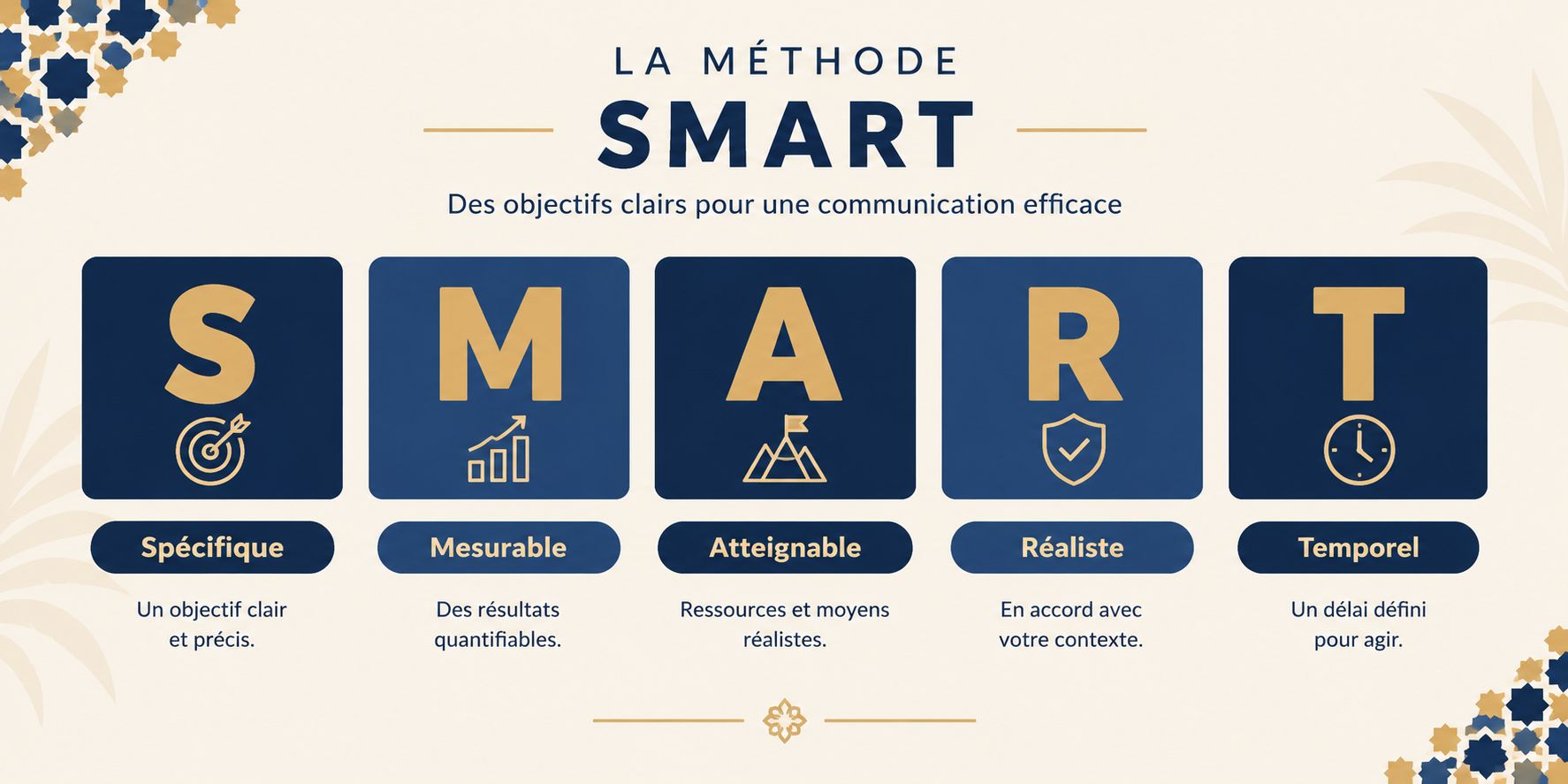
A useful method for wording these objectives is the SMART approach: an objective must be Specific, Measurable, Achievable, Realistic and Time-bound. In practice, instead of saying “we want to sell more”, you would say, as an illustrative example: “we want to increase our online orders by 20% within three months thanks to Instagram and a better product page”.
The problem is that many cooperatives want everything at once: more visibility, more sales, more loyalty and a better image, all with the same content and the same limited resources. In our view, this is exactly where communication loses effectiveness. A cooperative cannot pursue everything with the same intensity at the same time, especially when the team handling communication is small.
You need to choose one clear priority for a given period, then adjust afterwards. That choice is what brings consistency to everything else.
3. Identify Your Target Audience and Adapt Your Message
Once the objective is defined, the next question is: exactly who is the cooperative talking to?
It isn’t enough to say “our customers are people who like our products”. That is far too broad. You need to build a more precise profile: who is this person, what do they need, what problem are they trying to solve, what motivates them to buy and what holds them back.
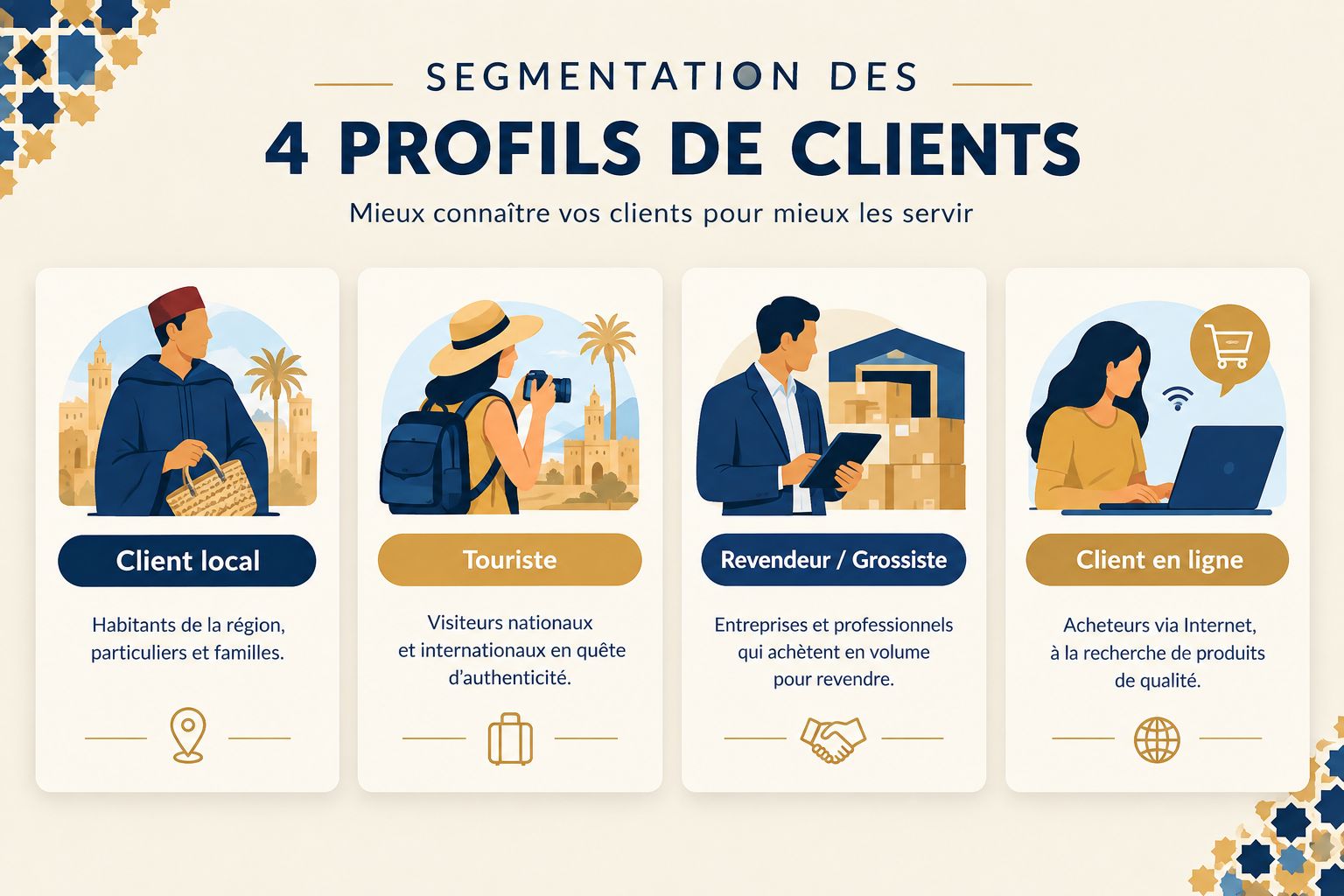
In the Moroccan context, the same cooperative can have several very different customer profiles, who should not receive exactly the same message. Take the fictional example of a cooperative selling argan oil and local crafts. It should not communicate in the same way with:
- a local customer, who already knows the product and mainly looks for quality and a good price;
- a tourist, who discovers the product during their stay in Morocco and needs to be told about its origin, authenticity and story;
- a reseller or wholesaler (shop, riad, export distributor), who cares more about volumes, margins and delivery reliability;
- an online customer, often ordering from another city or abroad, who wants reassurance about payment security, delivery times and after-sales service.
The same message doesn’t work for these four profiles. The problem is that many cooperatives use a single message for everyone, hoping to reach a wide audience. In reality, a message that tries to speak to everyone often ends up speaking to no one.
This is where many cooperatives go wrong: they think widening their message will widen their customer base. The opposite often happens. The more precise and tailored the message is to a target, the harder it hits — whether it is a sign at the cooperative’s entrance or an Instagram post.
4. Branding and Brand Image: Two Essential Elements of a Communication Strategy
What is branding?
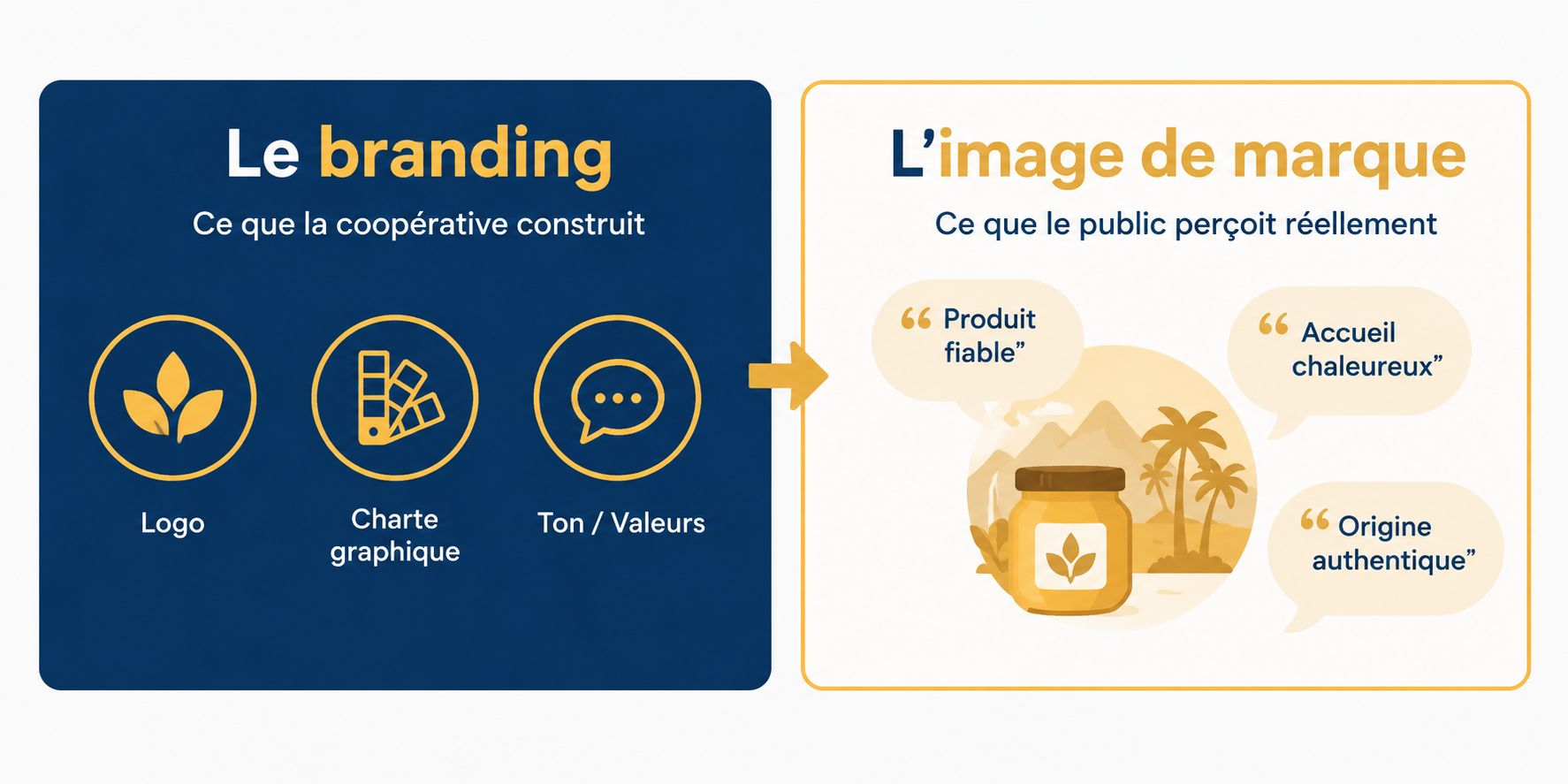
Branding is everything the cooperative deliberately puts in place to present itself: its name, positioning, values, visual identity (logo, colors, patterns), tone of communication, and the experience it offers to visitors and customers.
In practice, branding answers questions such as: who are we, what know-how do we stand for, how do we want to be perceived, and how do we show it concretely through our product label, our Facebook page, our packaging and the way we welcome visitors.
What is brand image?
Brand image is different. It is the public’s actual perception of the cooperative, regardless of what the cooperative intended to build. It is what people really think, feel and say when they hear the cooperative’s name or see its product at a friend’s home.
What is the difference between branding and brand image?
Put simply:
- Branding is what the cooperative builds and puts in place.
- Brand image is what the public actually perceives.
A cooperative can have careful branding, a beautiful label and a consistent visual identity, and still have a poor brand image if the real experience doesn’t match. Take a fictional example: a weaving cooperative may have beautiful photos of its rugs on social media.
But if delivery deadlines are never met, if nobody answers WhatsApp messages, or if quality varies from one piece to another, the real brand image will be negative, no matter how good the photos posted online are.
What really makes the difference is consistency between what the cooperative shows and what it actually delivers. Branding attracts attention, but it is the experience that builds brand image over the long term.
5. Which Channels Should You Use in a Digital Communication Strategy?
Once the objective, target and positioning are clear, the question of channels comes up. There are many options:
- The website, the foundation of any serious digital presence, especially for selling abroad or reassuring an online buyer;
- SEO, to be visible on Google when someone searches for “Moroccan argan oil” or “artisanal cooperative Essaouira”;
- Social media (Facebook, Instagram), to build connections and show the daily life of the cooperative and its members;
- Digital advertising, to speed up results on a specific product range;
- Email marketing, to retain regular buyers and resellers;
- The Blog, to tell the story of the know-how, the members and the production process;
- Video, increasingly essential for showing craftsmanship and capturing attention;
- WhatsApp, particularly relevant in the Moroccan context for direct customer relations, order taking and delivery tracking;
- Markets, trade fairs and partner cooperatives, for physical presence and word of mouth, often complementary to digital.
But here is an important point: being everywhere is not a strategy. It is often the opposite of a strategy, because it scatters the energy and the already limited resources of a cooperative.
The right channel depends on several combined factors: the target you want to reach, the objective you are pursuing, the type of content you can produce with the cooperative’s means, and the time members actually have available.
An artisanal cooperative selling authentic products will probably benefit more from investing in Instagram, local SEO and a well-organized WhatsApp presence than from spreading itself across five different social networks with few resources.
Conversely, a cooperative mainly targeting export to European distributors will find more value in a solid website, complete product sheets and blog content explaining traceability than in TikTok
6. How to Create an Effective Communication Plan
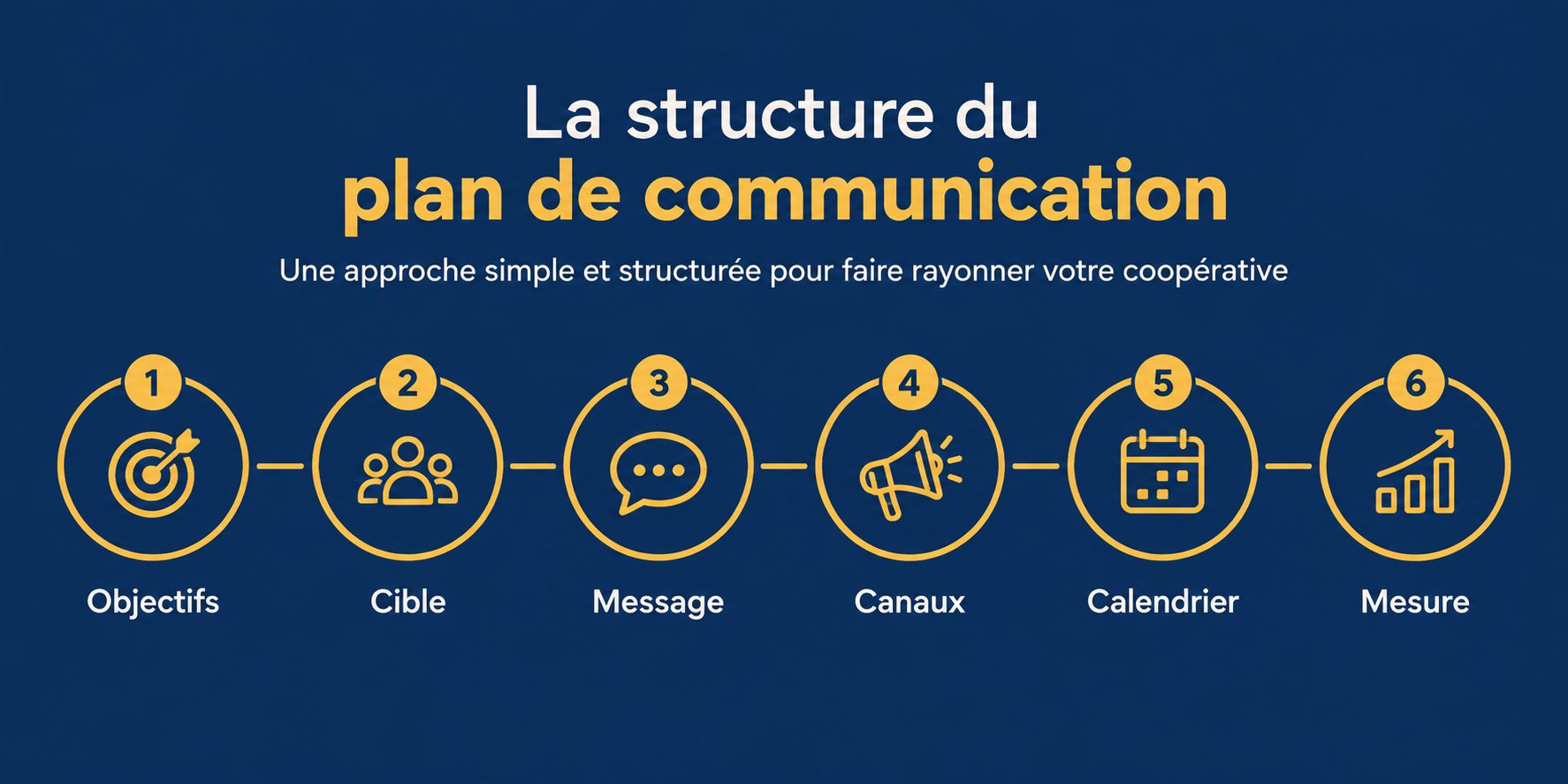
A good communication strategy needs a concrete plan to turn into action. Here is a simple method to follow:
- Analyze the cooperative’s current situation, its existing communication and its market.
- Define the objectives clearly and prioritize them.
- Identify the target precisely, with its needs and barriers.
- Define the positioning — what makes the cooperative different.
- Build the core message that will guide all content.
- Choose the most relevant channels according to the target and resources.
- Create content adapted to each channel.
- Set up a realistic publishing calendar the team can maintain.
- Define the available budget for production and advertising.
- Measure results regularly.
- Keep optimizing based on the data.
A concrete example (fictional, for illustration)
A women’s weaving cooperative, which we will call “Tifaout Cooperative”, could set the following objective: increase its online sales by 15% in three months. Its main target would be urban Moroccan buyers and diaspora customers interested in authentic, hand-woven pieces. Its positioning would highlight the know-how passed down among the women of the cooperative and the guaranteed origin of each piece. It would choose Instagram and local SEO as its main channels, post twice a week, with a small monthly budget for a few sponsored posts, and track its results through website traffic and WhatsApp orders.
This plan is nothing complicated. What matters is that it is consistent from start to finish, and not built from separate decisions made at random.
7. Measure Your Results and Improve Your Communication Strategy
A communication strategy is never set in stone. It must be adjusted based on real results, not impressions.
The most useful indicators to track are:
-
- Reach: the number of people reached;
- Impressions: the number of times the content was displayed;
- Engagement: likes, comments and shares;
- Traffic: visits generated to the cooperative’s website;
- Clicks: real interest in a product or offer;
- Leads: interested contacts generated (WhatsApp messages, quote requests from a reseller);
- Conversions and sales: the final result sought;
- Acquisition cost: what each customer actually costs you, important when the budget is limited.
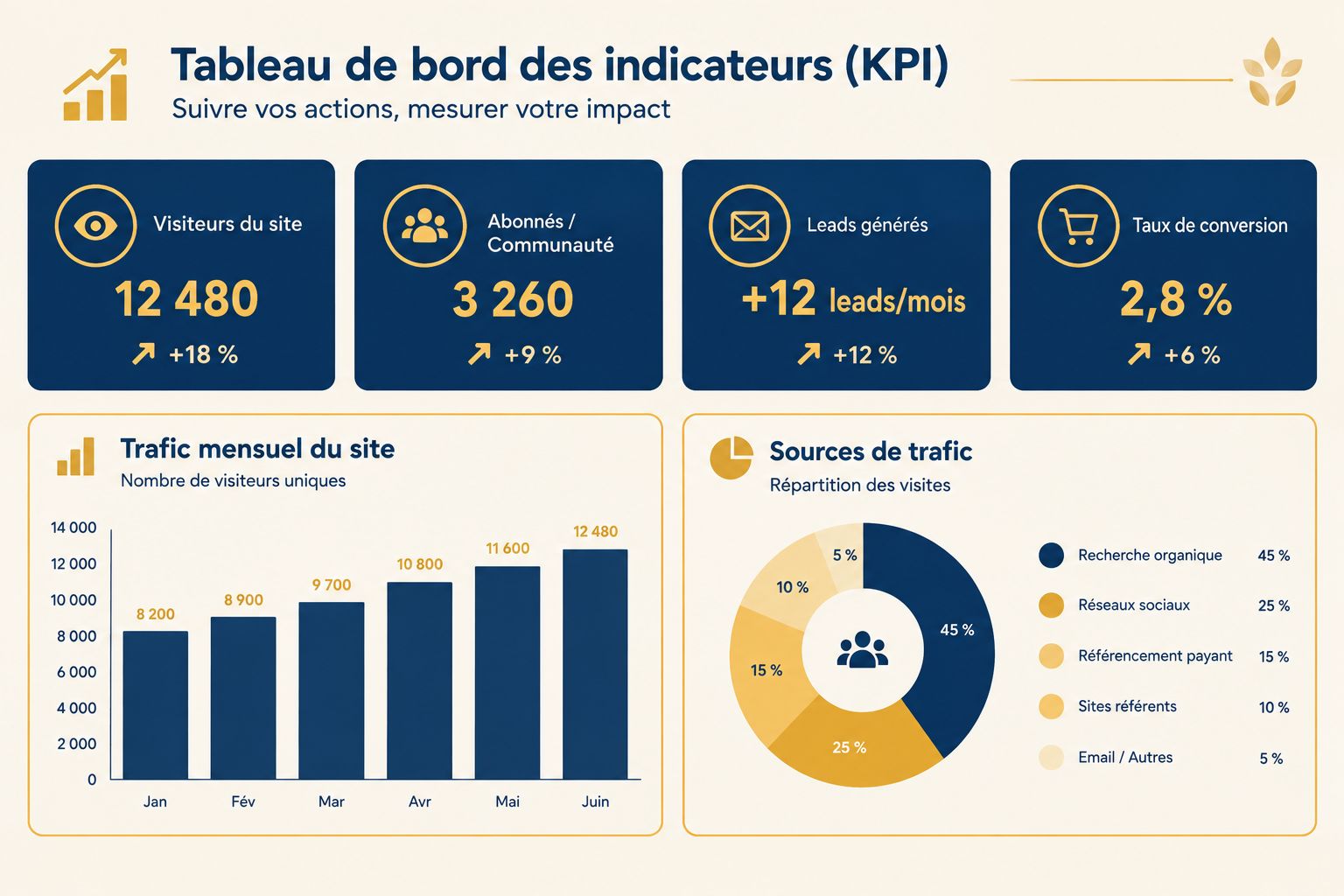
The problem is that many cooperatives focus only on likes and views, believing these numbers reflect their success. In reality, more likes doesn’t necessarily mean more sales. A post can be very popular without generating a single order, while another, less spectacular one can convert much better because it speaks precisely to the right person at the right time — for example a reseller who was looking for a reliable supplier.
“The real question is not ‘how many people saw this content’, but ‘did this content bring the cooperative closer to its goal’.”
This reading of the data is what allows you to adjust the message, the format or the channel, and to improve the strategy month after month.
A good communication strategy is not necessarily the one that lets a cooperative talk the most. It is the one that lets it talk to the right people, with the right message, at the right time and on the right channel.
This may be the most important thing to remember from this whole article. Many cooperatives think they need to post more, be everywhere and produce more content. In reality, quantity never replaces clarity. A cooperative that knows exactly who it is talking to and why builds much stronger communication than one that publishes without clear direction.
Building a communication strategy takes time: defining your objectives, understanding your target, clarifying your branding, choosing the right channels and measuring your results. It is not a one-off exercise, but ongoing work that adjusts as feedback comes in from the market.
Want to structure your cooperative’s communication?
At Webdono, we support Moroccan cooperatives and businesses in creating websites, SEO, digital marketing and branding, to build a consistent and effective online presence.
This is precisely the kind of support that Webdono offers to Moroccan cooperatives that want to structure their digital communication, whether through a website, an SEO strategy, a social media presence or a more consistent brand identity.
-
- And you — where does your cooperative’s communication stand today?
- Does your cooperative currently have a real communication strategy?
- In your opinion, what is the biggest challenge in building a strong brand image as a cooperative?
- Which communication channel works best for your activity?
Feel free to share your experience in the comments.
FAQ
Communication Strategy for a Cooperative
What is a communication strategy for a cooperative?
It is a structured action plan that defines why a cooperative communicates, who it is talking to, what message it conveys and through which channels, in order to reach specific goals rather than posting at random.
What is the difference between branding and brand image for a cooperative?
Branding covers everything the cooperative deliberately builds (name, visual identity, tone, positioning), while brand image is the public’s actual perception of it, based on their real experience of the products and service.
What are the most effective channels for a Moroccan cooperative?
It depends on the target and the objective. The website, local SEO, Instagram and WhatsApp are often relevant for a Moroccan cooperative, but the best channel remains the one that truly matches the intended clientele (local, tourist, resellers or export).
How do you define your target in digital communication when you are a cooperative?
You need to identify the needs, motivations and barriers of each customer profile, because a cooperative may have several types of customers (local, tourist, reseller, online buyer) who require different messages.
How do you measure the effectiveness of a communication strategy for a cooperative?
By tracking concrete indicators such as traffic, engagement, leads and conversions, rather than limiting yourself to the number of likes, which does not always reflect the orders actually obtained.


